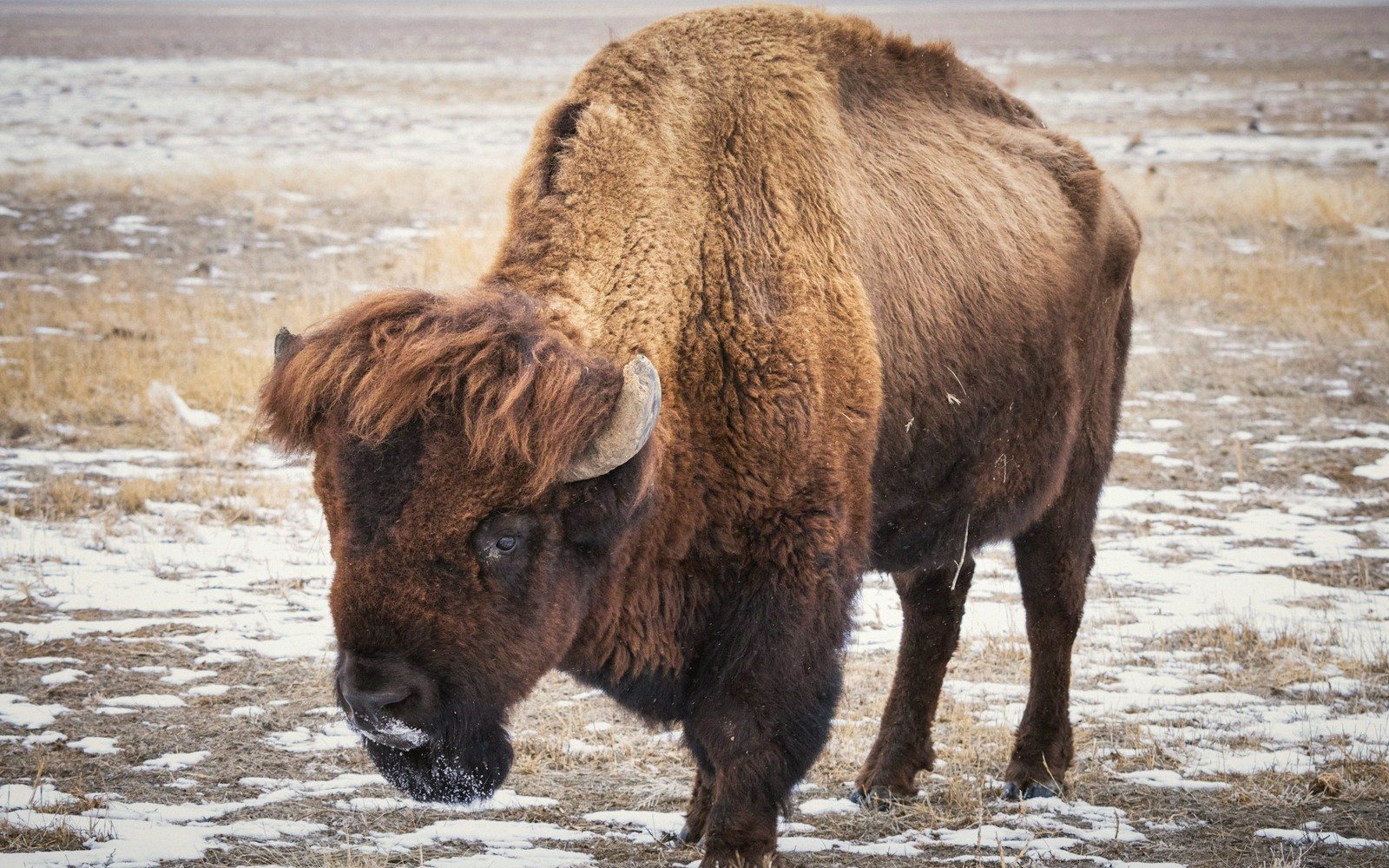
The Animal That Made the Plains Livable
Before the railroads, before the cattle drives, before any European name appeared on a map of the interior grasslands, bison moved across the Great Plains in herds so vast that travelers described the earth itself appearing to move. Estimates of the pre-contact population range widely, but historians and ecologists generally accept somewhere in the range of thirty to sixty million animals grazing from present-day Canada to Texas.
For the nations of the Plains — the Lakota, Comanche, Blackfoot, Cheyenne, Crow, Kiowa and their neighbors — the bison was not simply a food source. It was the organizing principle of material life. Every major need that the grassland environment posed, the bison answered. Hide became shelter, clothing, moccasins, shields, and the covers of tipis. Sinew became bowstring and thread. Bone became tools: scrapers, needles, sled runners. Stomach lining became water vessels and cooking pots. Fat was rendered for cooking and for treating leather. Dung — dried into chips — fueled fires on a treeless plain. Almost nothing was wasted, because almost nothing could be.
Pemmican, a dense mixture of dried meat, fat, and berries, allowed the preservation and transport of nutrition across long migrations and hard winters. It was, in effect, a portable calorie store that made semi-nomadic life not just possible but sustainable. Trade in hides, pemmican1, and robes connected Plains nations to agricultural peoples along the Missouri River — the Mandan, Hidatsa, and Arikara — creating economic networks that ran hundreds of miles in every direction.
The horse, reintroduced to the Plains by Spanish colonization and spreading northward through Indigenous trading networks during the seventeenth and eighteenth centuries, transformed the hunt without replacing its logic. Mounted hunters could now follow herds over greater distances and take animals more efficiently, which expanded the surpluses available for trade and strengthened the political power of nations who excelled at it. The horse era is often treated as the "classic" Plains culture — it was real, and it was brilliant, but it was also relatively brief, lasting perhaps a century and a half before it was violently interrupted.
The Slaughter and Its Purpose
The near-extinction of the bison in the nineteenth century was not an accident of overhunting. It was a policy. Military commanders and U.S. government officials understood, and sometimes stated plainly, that destroying the bison herds would destroy the economic and physical independence of Plains nations more effectively than any campaign of direct warfare.
Commercial hide hunters, armed with high-powered rifles and backed by railroad supply lines, did the work with industrial speed. In the 1870s alone, millions of animals were killed annually, their hides shipped east and their carcasses left to bleach on the prairie. By the late 1880s, fewer than a thousand wild bison remained on the continent. Nations that had organized their entire lives around the animal's abundance were left, within a generation, without the resource that had made that life possible — and were then confined to reservations and made dependent on federal rations, often inadequate, as a deliberate mechanism of control.
The human consequences were catastrophic. The loss of the bison did not end Plains cultures, but it shattered the material foundation that had supported them, and it arrived alongside land dispossession, the reservation system, and the suppression of cultural practice. Grief over the bison's loss runs through oral traditions, Ghost Dance prayers, and the testimony of elders recorded in the decades that followed.
The long view
- 17th–18th centuryhorses spread northward through Indigenous trade networks, transforming Plains bison hunting
- 1870speak of commercial bison slaughter; millions killed annually
- Late 1880swild bison near extinction; fewer than a thousand remain
- Early 20th centuryconservation efforts begin recovering the species
- 1992InterTribal Buffalo Council founded
Return
The bison's return is one of the more quietly significant ecological and cultural stories of the past century. Conservation efforts beginning in the early twentieth century pulled the species back from the brink. Today, roughly half a million bison exist in North America — still a fraction of their former numbers, but a living population.
Tribal nations have been central to this recovery. The InterTribal Buffalo Council3, founded in 1992, coordinates the restoration of bison to tribal lands across more than sixty member nations. For nations whose relationships to the animal stretch back thousands of years, returning bison to their homelands is not simply wildlife management. It is an act of cultural restoration — reestablishing a relationship that commercial slaughter interrupted but did not erase.
The bison's return is one of the more quietly significant ecological and cultural stories of the past century.
Bison now graze on the Blackfeet Reservation in Montana, on Standing Rock, on the Cheyenne River lands of South Dakota, and on the Fort Peck Reservation, among many others. The work of restoration is ongoing, patient, and grounded in the same understanding that Plains peoples held long before any European arrived: that the bison and the land and the people belong together.
People & places in this guide
Lakota, Comanche, Blackfoot, Cheyenne, Crow, Kiowa
In this guide
Plains nations whose cultures centered on the bison
Mandan, Hidatsa, Arikara
In this guide
agricultural Missouri River peoples who traded with Plains nations
InterTribal Buffalo Council
In this guide
founded 1992; coordinates tribal bison restoration programs